
Backrooms Smiler Guide: Signs, Behavior & Survival Tips
A Backrooms Smiler is usually described as a hostile entity recognized by reflective eyes and a bright smile in darkness. The useful answer is source-aware: community lore may describe light, eye contact, and slow retreat, while a game can turn the same idea into a chase, hiding, or puzzle mechanic. This guide explains what to notice, what not to assume, and how to read Smiler advice without mixing every canon together.
What is a Smiler in the Backrooms?
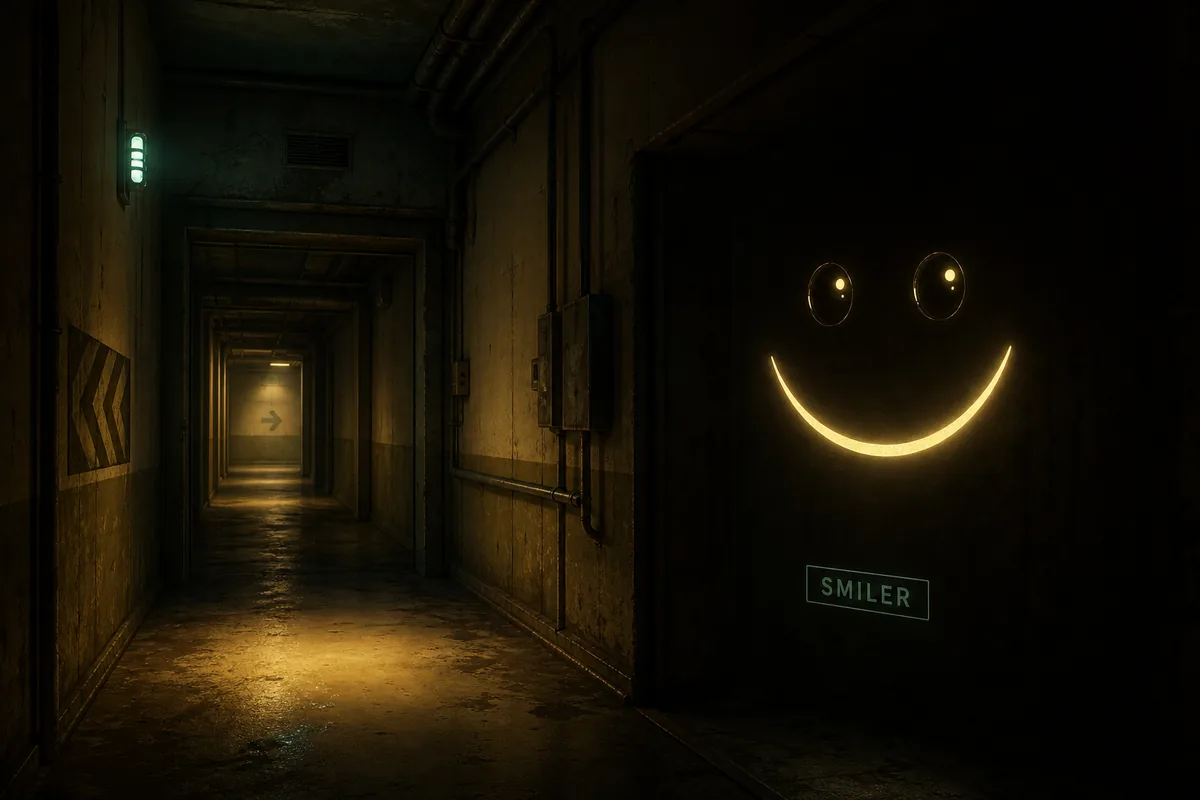
The Backrooms Smiler is a community entity commonly portrayed as a pair of bright eyes and a wide smile suspended in a dark area. The Backrooms Wiki entry for Entity 3 describes Smilers as generally hostile and connects them with dark areas, including Level 2 and Level 3 in that specific continuity. That is a useful source description, not a universal rulebook for every Backrooms story, video, or game.
For a beginner, the important distinction is between recognition and certainty. Seeing a smile-shaped light in a fan illustration does not prove that a Smiler is present in every canon. Likewise, a game may use a Smiler-inspired enemy but give it a fixed patrol route, a chase trigger, or a puzzle rule that does not appear in the lore source.
The safest reading order is simple: identify the source, check the visual cue, separate the claimed behavior from the game mechanic, and only then follow a survival tip. This keeps backrooms smiler searches useful for lore readers and players without turning one community interpretation into an official fact.
| Question | Short answer | Why the source matters |
|---|---|---|
| What does a Smiler look like? | Bright eyes and a wide smile in darkness are the common cues. | The exact design changes across wikis, art, videos, and games. |
| Is a Smiler always a monster? | It is usually framed as a hostile entity in community lore. | A game can simplify the threat into a readable mechanic. |
| Is Entity 3 the same everywhere? | Entity 3 is a source-specific label, not a promise of one canon. | Check the wiki, creator, or game page being discussed. |
| What should a reader do first? | Confirm the source before applying advice. | Lore instructions and game controls solve different problems. |
How to recognize a Smiler
The most useful recognition cue is not a detailed body shape. It is the contrast between a dark environment and a small set of reflective features: eyes, teeth, or a smile that seems to float where a face should be. The Backrooms Wiki source describes reflective eyes and teeth gleaming in the dark. Other sources may draw the smile differently, so treat the visual as a pattern rather than a strict character model.
Lighting is part of the clue and part of the confusion. A bright corridor can hide the visual contrast that makes a Smiler recognizable, while a screenshot, video edit, or game effect can make an ordinary light look like an entity. Before reacting, look for repeated behavior, movement, or a source-specific rule instead of trusting one frame or one dramatic description.
The word Smiler also covers several search contexts. A lore reader may want appearance and origin. A player may want to know whether a creature reacts to a flashlight, noise, distance, or line of sight. A viewer may be asking about a creator's interpretation. Use the question around the keyword to decide which evidence belongs on the page.
Smiler behavior: lore versus game mechanics
In the checked Entity 3 source, Smilers are described as hostile, attracted to light, and safer to handle through eye contact and a slow retreat. The same page also frames some biological details as unknown or rumored. That mix is important: a guide can report what a source says while still labeling uncertainty instead of presenting every detail as a verified fact.
Games need clearer feedback than a lore page. A developer may make a Smiler react to a flashlight beam, trigger a chase after a noise event, disappear when a player reaches a checkpoint, or appear only in a particular level. Those rules can be inspired by the entity concept without being a literal translation of the wiki entry.
The comparison below is therefore a reading aid, not a claim that one side is more official. Use the lore column when you are studying a community continuity. Use the game column only after identifying the title, level, platform, and current build. If a walkthrough says to press a key, hide in a locker, or complete an objective, that is game-specific information and should be verified against the game's own guide or store context.
This distinction also protects the page from overclaiming. The primary keyword is backrooms smiler, but the article does not promise one universal weakness, one official habitat, or one guaranteed escape action. It gives a method for comparing sources and a calm set of general decisions that do not depend on pretending every version is identical.
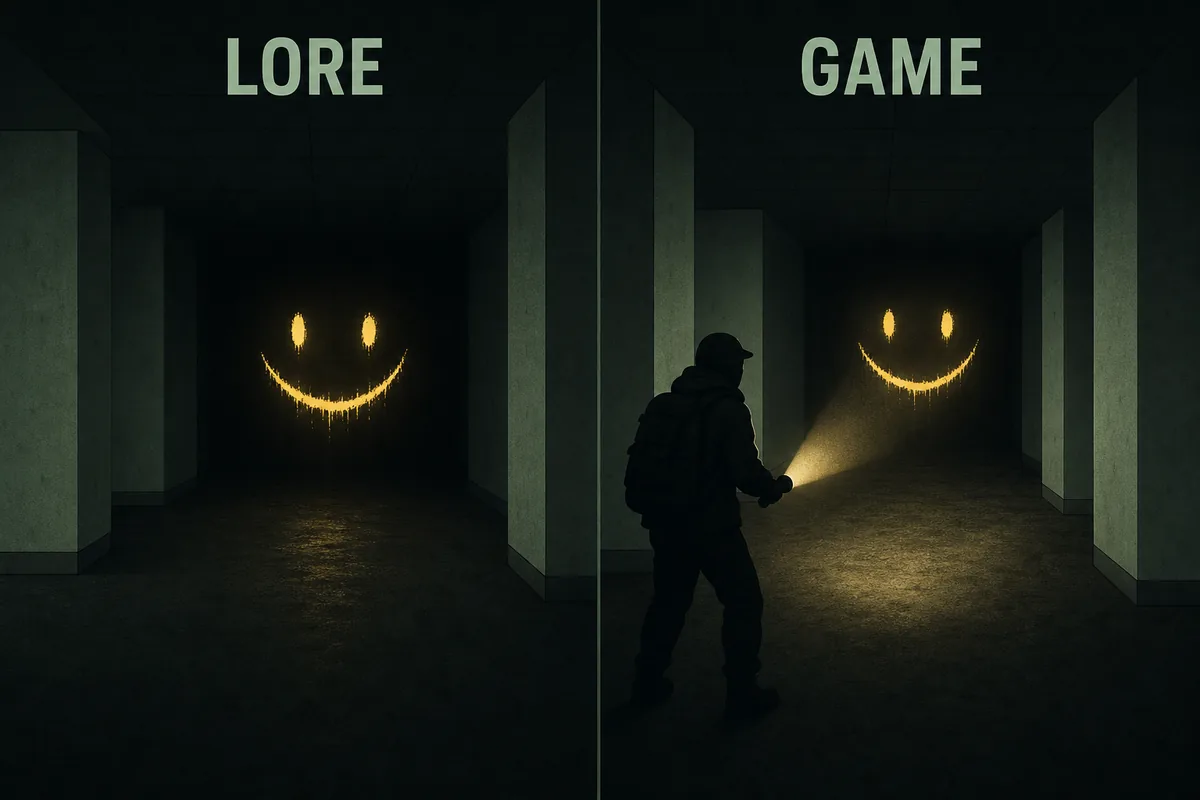
| Claim type | Community-lore reading | Game-page reading |
|---|---|---|
| Appearance | Reflective eyes and a glowing smile are common cues. | The model, effect, and visibility depend on the title. |
| Light | The checked source describes attraction to light. | A flashlight may attract, reveal, stun, or do nothing. |
| Movement | Slow retreat and eye contact are source-specific guidance. | Chase, patrol, trigger, and safe-zone rules are game-specific. |
| Certainty | Rumor and unknown biology should stay labeled. | Patch notes, walkthroughs, and the current build control the answer. |
What to do when you notice a Smiler
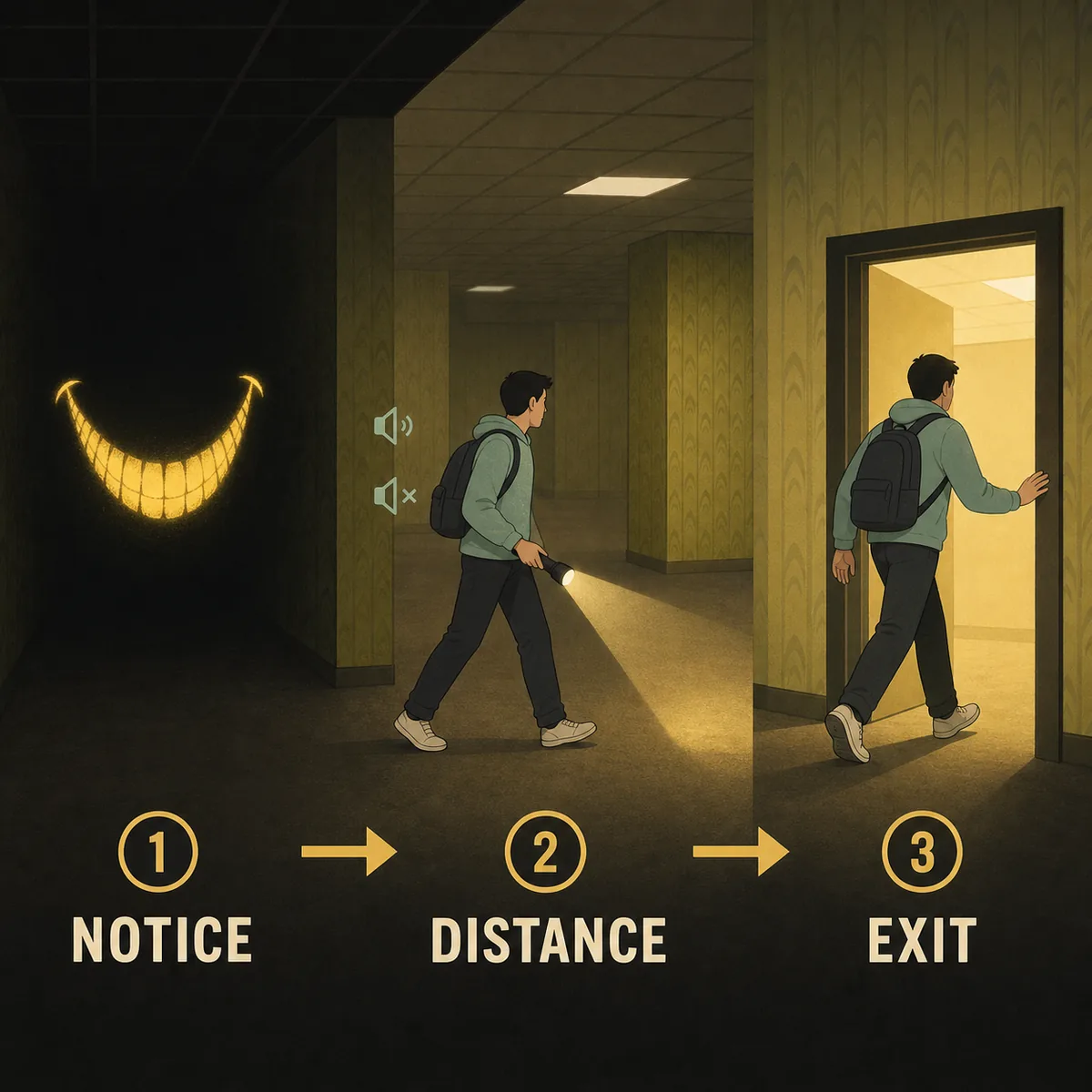
The following sequence summarizes the checked community-lore advice while keeping its scope clear. It is not real-world emergency guidance, and it is not a guaranteed solution for every game. In a game, follow the controls and objective rules for that title first. In a lore discussion, use the sequence as a way to compare what a source actually says.
First, notice the cue without rushing into a blind turn. Confirm that the eyes and smile are part of the scene rather than a reflection, graphic effect, or teammate light. Second, create distance deliberately. The Entity 3 source emphasizes eye contact and slow movement, while other games may reward hiding, turning off a light, or reaching a checkpoint. Third, move toward a known route or exit only when the source gives you a reason to trust it.
The most common mistake is to combine incompatible rules. A player sees a lore sentence about light and assumes every game requires the same response. Another reader sees a game chase and rewrites the wiki entity around it. Keep the source name beside the advice, and treat an uncertain claim as uncertain.
A short communication pattern helps co-op players: say the location, the visual cue, the direction of retreat, and the next objective. Avoid dramatic callouts that hide the useful information. This makes a Smiler page practical without pretending that a fictional entity has one scientifically verified behavior.
- Identify the source: wiki, video, game title, or fan continuity.
- Check the cue: eyes, smile, darkness, movement, and repeated behavior.
- Keep a retreat route and communicate the next landmark clearly.
- Apply only the mechanic or lore advice that belongs to that source.
- If the behavior is unknown, label it unknown instead of inventing a weakness.
Where do Smilers appear in the Backrooms?
The checked Backrooms Wiki Entity 3 page places Smilers in dark areas on Level 2 and Level 3, and names the Smiling Room as their base in that continuity. That is a useful answer for readers who are specifically using that source. It should not be stretched into a universal map for all levels, games, or video series.
Level context changes the practical question. In an industrial corridor, a player may care about noise, pipes, and a route marker. In a dark game room, the important rule may be a flashlight, a hiding place, or a scripted trigger. On a general lore page, the useful detail is the source label and the reason the environment matters.
If another page claims that Smilers appear everywhere, compare its source before calling it a contradiction. Backrooms terms are reused by separate communities. The table below keeps the strongest checked claim narrow and leaves other variants open for verification.
| Context | What this guide can say | What still needs checking |
|---|---|---|
| Entity 3 source | Level 2 and Level 3 dark areas are named. | Revision history and local page rules. |
| A specific game | Use the game's level and enemy behavior. | Title, platform, version, and walkthrough date. |
| A video continuity | Use the creator's visual and story rules. | Whether the entity is actually confirmed on screen. |
| A new fan wiki branch | Treat its page as that branch's canon. | Its source policy, citations, and relationship to other branches. |
Common Smiler mistakes and a source-check checklist
Mistake one is treating every glowing smile as the same entity. Art direction, video effects, and game models borrow familiar imagery. Recognition is a reason to investigate, not proof that the same canon is in use. Mistake two is copying a game walkthrough into a lore paragraph without naming the game. That creates a page that sounds confident but cannot answer a reader's actual question.
Mistake three is presenting rumored biology as established fact. The checked source itself separates what can be recognized from what is unknown. A trustworthy Backrooms Smiler guide should preserve those labels, mention where a claim came from, and avoid turning fan interpretation into official production information.
Before publishing or sharing an entity claim, ask four questions: What source said it? Is the detail visible or inferred? Does the claim describe lore or a game mechanic? What would change if the source revision or game build changed? These questions are more useful than a longer monster list because they keep the answer stable and honest.
- Do not call generated concept art an official screenshot.
- Do not treat one wiki branch as the only Backrooms canon.
- Do not carry a game-specific weakness into every lore page.
- Do not state that a movie contains a Smiler without a checked source.
- Do label the source, confidence, and limits of each behavior claim.
Backrooms Smiler FAQ
What does a Smiler do in the Backrooms?
In the checked Entity 3 community source, Smilers are generally hostile, associated with darkness, attracted to light, and described with eye contact and slow retreat guidance. A game may implement different behavior, so verify the title and level before applying the lore description.
How do you survive a Smiler?
Start by identifying the source. For the checked lore interpretation, keep eye contact, avoid panic, and move away slowly; for a game, use the current game's controls, objective rules, and verified walkthrough because the mechanic may be different.
What level do Smilers appear in?
The checked Backrooms Wiki Entity 3 page names dark areas on Level 2 and Level 3 in that continuity. Other wikis, videos, and games can place or use Smilers differently.
Are Smilers and Entity 3 the same thing?
Entity 3 is the label used by the checked Backrooms Wiki page for Smilers. Treat that name as source-specific and check the page or game being discussed before assuming every community uses the same numbering.
Should you turn off your flashlight around a Smiler?
Some community-lore advice discusses light, and the checked source says Smilers are attracted to light. A game may make light attract, reveal, disable, or ignore the enemy, so follow the specific game rule instead of applying one universal shortcut.
How do you beat Smilers in Escape the Backrooms?
That is a game-specific question. Check the exact level, platform, build, and current walkthrough for Escape the Backrooms. The general lore description on this page should not be treated as a guaranteed game strategy.
Are Smilers official Backrooms canon?
Smilers are a recognizable community Backrooms entity, but The Backrooms does not have one universal canon covering every wiki, game, video, and film project. Name the source when making a claim.