
Backrooms Level 9 Guide: The Suburbs, Routes and Entity Risks
Quick answer: Backrooms Level 9 is commonly described as The Suburbs, a seemingly ordinary residential neighborhood that becomes unsettling through repetition, darkness, and uncertain routes. The exact houses, entities, entrances, and exits depend on the wiki or game being discussed. This guide explains the shared idea first, then keeps lore claims separate from the playable Escape the Backrooms map.
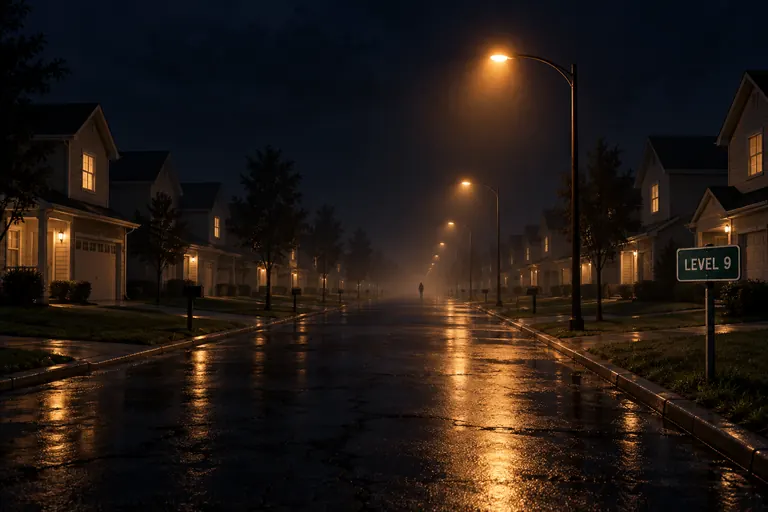
What is Backrooms Level 9?
Backrooms Level 9 is a residential level usually called The Suburbs. Instead of an office maze or a cave network, the setting looks like a quiet neighborhood: rows of houses, streets, driveways, streetlights, and occasional windows that suggest somebody is home. The ordinary appearance is the trap. Repeated blocks make it difficult to remember where you entered, while the lack of reliable landmarks turns a familiar road layout into a navigation problem.
Search results use several names for the same cluster. The Backrooms Wiki calls the setting The Suburbs, while other branches use Darkened Suburbs, Level 9, or a version tied to a particular story. Those labels are useful clues, not a promise that every page shares one canon. A careful Backrooms Level 9 guide names the source before claiming that a house is safe, that a creature appears, or that a particular road leads to Level 10.
The number also appears in Escape the Backrooms, where the level is a playable chapter with houses, computers, an outpost, and objectives. That game map answers a different question from a lore page. Lore readers want the atmosphere and source boundaries; players want the current objective order and a reliable route for their build. This page gives both contexts without presenting a game mechanic as universal Backrooms fact.
| Question | Short answer | Scope note |
|---|---|---|
| What is Level 9 called? | The Suburbs, sometimes Darkened Suburbs. | The wording changes by wiki or story. |
| What does it look like? | A repeating, mostly empty residential neighborhood. | An image can show mood, not a canonical map. |
| What makes it dangerous? | Darkness, repetition, isolation, and uncertain houses or entities. | Threat lists need a named source. |
| Is it a game level? | It can be, but the game version is its own continuity. | Check the title and build before using a walkthrough. |
The Suburbs environment and safe-house clues
The strongest recognition clue is not one house or one monster. It is the combination of normal suburban details and an absence of dependable human activity. Streetlights may work while the neighborhood remains empty. Houses may look occupied but provide no consistent answer about who lives inside. A road may curve back toward a familiar mailbox, yet the surrounding homes can be subtly different. The result is an environment that rewards careful notes more than confidence.
Treat a lit window, open garage, or quiet porch as an observation rather than a safe-house guarantee. In a lore continuity, the word safe may describe a temporary shelter, a reported refuge, or a fan interpretation. In a game, a safe house can be a fixed checkpoint or a house chosen by an objective system. Keep those meanings separate when explaining how to move through Level 9.
The concept image below is intentionally editorial. It visualizes the repeated street grid and the idea of a route that branches through a safe house, an outpost, and a possible exit. It does not reproduce a copyrighted wiki map or claim that every Level 9 version uses those exact points. Use it to understand the reading method: label what is observed, label what is sourced, and leave uncertain connections conditional.
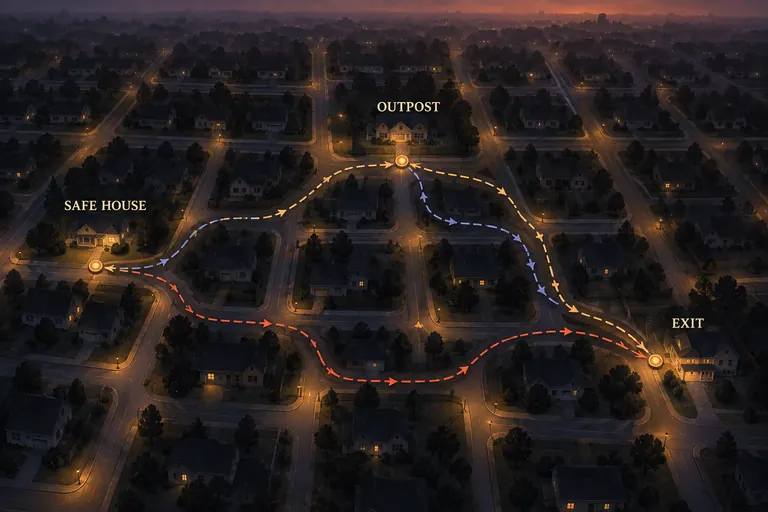
- Use street names, house numbers, light poles, and turning points as notes only when the source or game actually provides them.
- Do not assume a lit or furnished house is safe in every canon.
- Keep a return point in view; repeated blocks make a short detour hard to reverse.
- Mark an image as concept art or comparison media so readers do not confuse it with evidence.
Entities and hazards: what is actually supported
A Backrooms Level 9 search often mixes entity pages with route questions. The environmental hazards should come first: low visibility, repetitive streets, fatigue, false landmarks, and the temptation to enter a house without knowing its status. These hazards remain useful even when a source does not agree on a creature roster. They also explain why a calm neighborhood can be more dangerous than a visibly hostile corridor.
The word Wretch appears in the Escape the Backrooms map context, where a Wretch can be connected with an Administrator Card and the route to the Abandoned Outpost. That is a game-specific claim. A lore entry may use different entities or none at all. When an article says that a Wretch, Hound, or another entity is present, attach the statement to the source and avoid turning a player guide into a universal entity list.
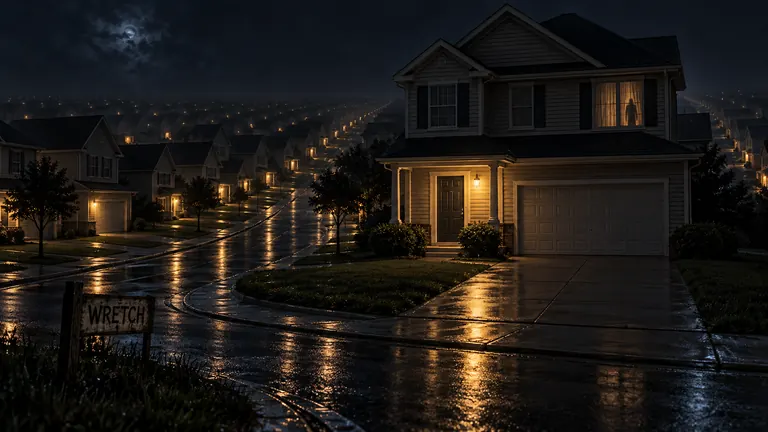
The warning image below is another AI-generated concept, not a gameplay capture. It emphasizes the editorial rule: a silhouette or warning sign can help a reader picture uncertainty, but it cannot prove that an entity is behind every lit window. Evidence comes from the named wiki, the official game page, or a current walkthrough that identifies its version.
| Claim type | How to label it | Reader action |
|---|---|---|
| Lore environment | Name the wiki or story continuity. | Use it to understand atmosphere and reported routes. |
| Community report | Say reported, disputed, or source-specific. | Do not treat it as a universal rule. |
| Game entity | Name Escape the Backrooms and the relevant build. | Follow a current game guide for behavior and objectives. |
| Visual concept | Call it AI-generated explanatory art. | Use it for orientation, never as proof of canon. |
Entrances, exits and how to read a Level 9 route
There is no single entrance-and-exit list that applies to every Backrooms Level 9 page. Wikidot lore can describe a transition from another level, a road, a doorway, or a conditional event. A Fandom branch may preserve a different route. A game may replace the whole idea with a chapter selection, an Administrator Card, a house puzzle, or an objective that opens the way to Level 10. The source boundary is more important than a dramatic but unsupported map.
When summarizing a lore route, use cautious verbs: may lead, is reported to connect, or is listed by the cited page. Explain whether the route is repeatable, conditional, or simply part of a narrative. If the source does not prove a return path, say so. This is especially important for the phrase how to get to level 9 backrooms, because searchers may be asking about a wiki entrance, a Roblox experience, or a specific game hub.
For the game version, use the official Steam listing and a current walkthrough as the authority for objective order. The map result checked for this brief describes safe houses, an Abandoned Outpost, computers, a Wretch, an Administrator Card, and an entrance to Level 10. Those details are useful for players, but they belong in the game lane. They should not overwrite the lore page's broader explanation of The Suburbs.
| Route question | Safe editorial answer | What to verify |
|---|---|---|
| How do I enter Level 9? | Follow the entrance listed by the named continuity. | Wiki branch, revision, or game title. |
| How do I leave it? | Describe exits as conditional connections. | Whether the route is lore or game logic. |
| Is the diagram a map? | It is an explanatory concept, not a canon map. | Creator, source, license, and scope. |
| Can I use it in Escape the Backrooms? | Only after checking the current build. | Steam page and updated walkthrough. |
Backrooms Level 9 lore vs. Escape the Backrooms
The phrase backrooms level 9 usually carries informational intent: readers want to know what The Suburbs is and why the setting is unsettling. The phrase escape the backrooms level 9 is more likely to mean a playable chapter, map, or puzzle. The two queries can share a number and a residential mood without sharing houses, checkpoints, entity behavior, or exits. A useful page answers the first query directly and then sends the second query to the game-focused guide.
This distinction also protects the site's existing topic cluster. Level 8 is already the cave-focused guide, Level 10 covers Bumper Crop, Level 37 handles Poolrooms imagery, and the entities hub owns broad monster explanations. Level 9 can link to those pages for comparison without trying to absorb their keywords. The goal is a clear path from level definition to the right supporting page.
Do not promise a download, a universal safe house, or a guaranteed escape route. The site is an editorial guide, not a game host. When a reader needs the playable solution, point them to the Escape the Backrooms guide and the official Steam listing, then remind them that updates can change puzzle order or entity behavior.
- Lore intent: define The Suburbs and state which source is being summarized.
- Route intent: report entrances and exits with source labels and uncertainty.
- Game intent: identify the title and build before giving objective steps.
- Mixed intent: answer the lore definition first, then link to the game guide.
A source-checking order for Level 9 searches
Start with the shared answer: Level 9 is commonly presented as The Suburbs, a repeating residential environment where darkness and missing landmarks make ordinary streets unreliable. Next, identify the source. The Backrooms Wiki, a Fandom branch, a video continuity, and Escape the Backrooms may all use the number while describing different rules. A source label turns a vague answer into a useful one.
Then separate observation from claim. A concept image can show a street, house, or route diagram, but it cannot prove a canonical entrance. A search snippet can reveal a likely topic, but it cannot settle whether an entity appears in every version. Read the environment, hazard, route, entity, and exit notes in that order, and keep each statement inside its evidence boundary.
Finally, choose the next page based on the question. Open the Backrooms Levels hub for cross-level comparisons, Level 8 or Level 10 for adjacent environments, the Entities guide for broad threat context, and the Escape the Backrooms guide for playable objectives. This reading order is the main information gain of the new page: it helps a reader avoid mixing lore and game maps while still finding the route they need.
Backrooms Level 9 FAQ
What is Level 9 in the Backrooms?
Level 9 is commonly called The Suburbs: a repeating residential neighborhood where darkness, isolation, and unreliable landmarks make navigation difficult. The exact rules depend on the source.
Why is Backrooms Level 9 called The Suburbs or Darkened Suburbs?
The names describe the level's ordinary-looking streets and houses. Different wiki branches and stories use slightly different titles, so the source should be named before details are treated as canon.
How do I get to Level 9 in the Backrooms?
There is no universal route. Check the named lore continuity first, because an entrance may be a conditional connection, a fan interpretation, or a game objective.
Are there entities in Backrooms Level 9?
Entity rosters vary. The Wretch and Administrator Card belong to the Escape the Backrooms game context checked for this guide; they should not be presented as a universal lore rule.
Is Escape the Backrooms Level 9 the same as the lore level?
Not automatically. The game uses a playable suburban chapter with objectives, houses, an outpost, and a route to Level 10. Use the current game guide for steps and keep its mechanics separate from wiki lore.