
Backrooms Level 11 Guide: The City That Never Sleeps, Exits and Lore
Quick answer: Backrooms Level 11 is commonly called The City That Never Sleeps in the English Wikidot continuity. It is an enormous urban level with roads, buildings, transit systems, settlements, entities, and a huge number of possible exits. The city is often described as a hub, but that does not make every route safe or every version of Level 11 identical. This guide separates the cited lore from game adaptations so you can understand the level before following a route claim.
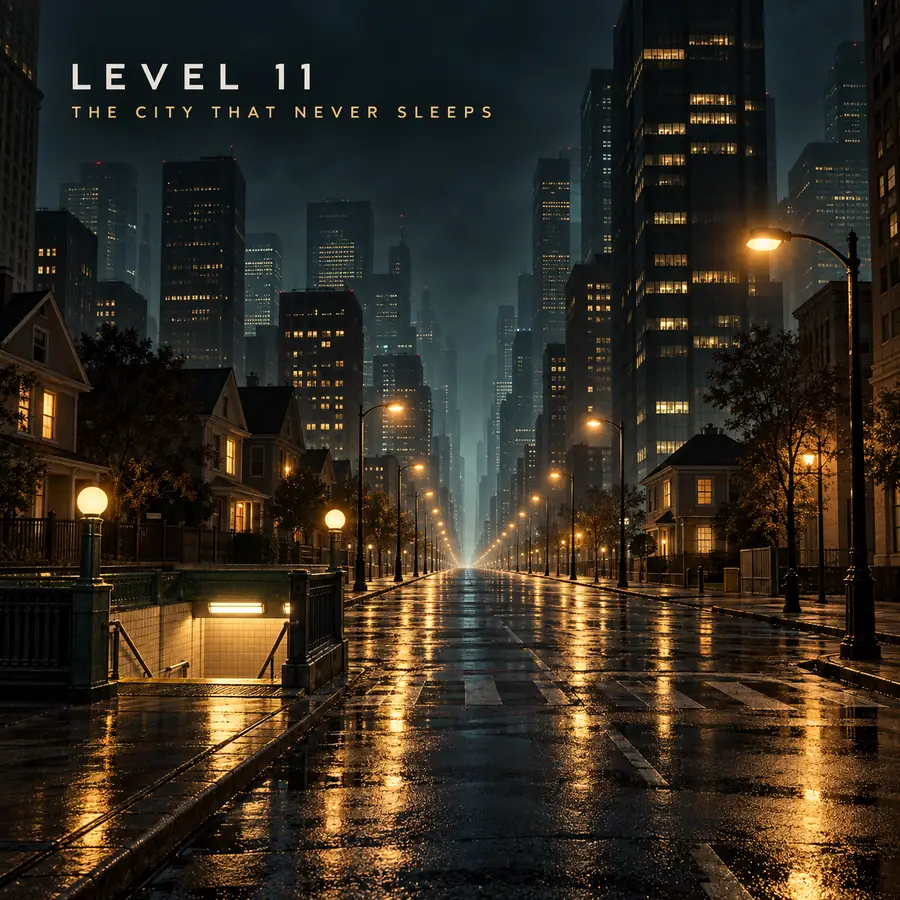
What is Backrooms Level 11?
Backrooms Level 11 is a vast city environment in the English Backrooms Wiki continuity. The page describes streets arranged in blocks, buildings that range from homes and offices to malls and museums, and transport systems that continue far beyond a normal city map. The level feels familiar at first because it borrows the visual grammar of a Western metropolis, but its scale and behavior make it impossible to treat as an ordinary neighborhood.
The name The City That Never Sleeps describes more than a busy skyline. Level 11 is presented as self-sufficient and constantly changing: supplies move through hidden systems, vehicles shift when unobserved, and districts can feel different as a traveler crosses from dense towers to quiet suburban blocks. The city can offer shelter, trade, and information, yet its many exits also create the risk of becoming lost in a place that has no reliable edge.
The exact answer depends on the source. Wikidot lore, Fandom pages, videos, Roblox experiences, and Steam games may all use the number 11 while changing the map, entity rules, or objective. This page summarizes the cited Wikidot version and labels game advice separately. It is an informational lore guide, not a promise that one route works in every Backrooms canon.
| Question | Short answer | Scope note |
|---|---|---|
| What is it? | A huge city level with roads, buildings, and transit. | The description belongs to the named source. |
| Why is it a hub? | It has many entrances and exits to other levels. | A hub is not the same as a safe checkpoint. |
| Is it inhabited? | The cited lore includes settlements, groups, and entities. | Populations and factions vary by continuity. |
| Is it a game map? | Not automatically. | Use the game's current guide for playable objectives. |
The endless city: blocks, buildings, and hidden infrastructure
The clearest way to recognize Level 11 is to read its built environment as a system. Roads follow block patterns, secondary streets connect to alleys and parking areas, and districts shift gradually between high-rise density and low-rise neighborhoods. Apartments, offices, schools, shops, gyms, factories, rail lines, subways, canals, and bridges can all appear. A quiet residential street is therefore not proof that a traveler has left the city level; it may simply be a lower-density district.
The Wikidot page also describes infrastructure that is more complete than its empty streets suggest. Electricity, water, waste handling, food production, and manufacturing operate through specialized structures and unseen transfers. Some buildings have sparse interiors, while other facades are sealed or show only black, mirror-like windows. The contrast gives Level 11 its distinctive unease: a city can look abandoned while still behaving as if a hidden economy is running behind the walls.
For readers, the important distinction is between a visual clue and a route guarantee. A subway entrance, a canal, a lit shop, or a large road can help identify the setting, but none proves that the next turn leads to a specific level. The city is best understood as a changing network. Marking a landmark and preserving a return direction is more useful than assuming that a familiar building will remain in the same place.
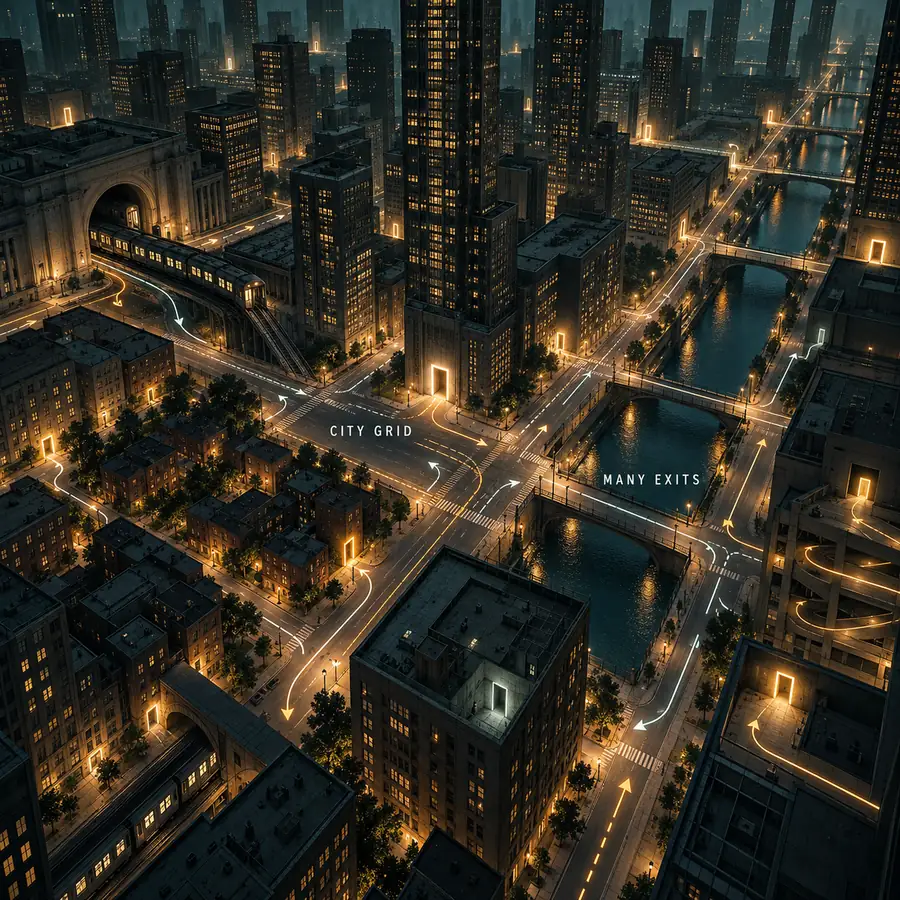
- Dense towers and low-rise suburbs can belong to the same level.
- Subways, canals, roads, and service corridors may extend beyond visible landmarks.
- A building facade or street light is evidence of atmosphere, not proof of an exit.
- The cited source describes infrastructure that can operate without visible residents.
Entrances, exits, and why Level 11 routes need a source
Level 11 is famous for connecting to many other levels, but the word many should not be turned into a universal route map. The Wikidot entry says that access can happen from almost anywhere and that the level does not list every connection. Exits may be inconspicuous, one-way, or located in places that are difficult to revisit. A traveler who treats the city as a simple crossroads can easily leave the known route and lose the context needed to return.
A careful lore summary should describe an entrance or exit as a source-listed possibility. Name the level, doorway, district, or phenomenon that the source identifies, then state whether the connection is common, conditional, or uncertain. If another wiki uses a different connection, keep it in a separate note. This wording is not a technicality: it stops a game checkpoint, a fan map, and a collaborative wiki claim from being blended into one misleading instruction.
For gameplay, the page boundary is even more important. A game may use Level 11 as a hub room, a menu-like lobby, or a chapter with fixed doors and objectives. Those mechanics are not established by the Wikidot page. Searchers asking for a code, a computer location, or a co-op route should move to the named game guide and verify its current build. Lore readers can use the comparison table below to understand why the two answers differ.
| Route question | Safe answer format | What to verify |
|---|---|---|
| How do I enter Level 11? | Describe the named source's possible connection. | Wiki branch, revision, and qualifier. |
| How do I leave it? | Treat exits as conditional or source-specific. | Direction, destination, and whether it is one-way. |
| Is there a complete map? | Expect partial maps and marked districts. | Creator, date, license, and scope. |
| Can I follow it in a game? | Only after naming the game and version. | Current objectives, checkpoints, and platform guide. |
Entities, settlements, and the Level 11 Effect
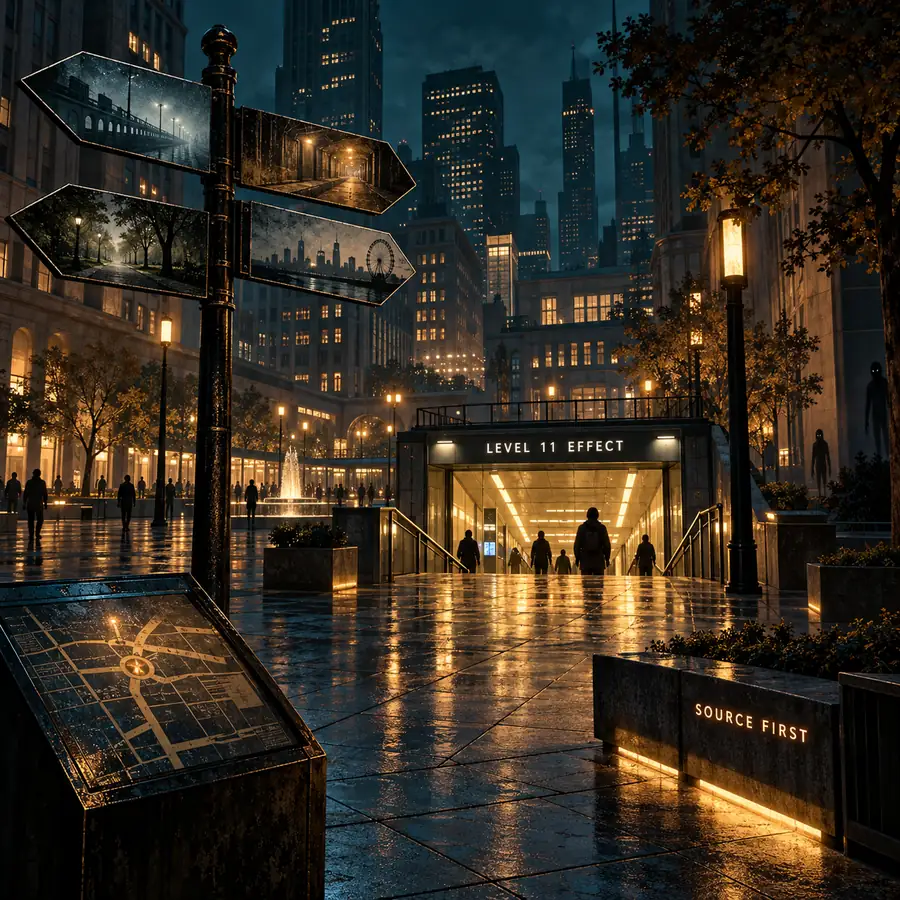
Level 11 is not defined by one resident monster. The cited lore describes a mixture of entities arriving from other levels, with Facelings and Hounds among the commonly mentioned creatures. It also discusses groups, markets, research facilities, and settled areas. That combination creates a different kind of danger from a chase level: the risk can come from a hostile encounter, an unfamiliar district, a misleading refuge, or the simple problem of walking too far without a return plan.
The Level 11 Effect is another source-specific idea. The Wikidot article describes a tendency for hostile entities to become less inclined to attack, while warning that the effect is not foolproof and can fail when a creature is provoked or unaffected. It should therefore be explained as a reported lore phenomenon, not as a universal safety mechanic. A game may omit it, turn it into a difficulty rule, or replace it with ordinary enemy behavior.
When comparing entity claims, separate four things: a creature listed by the source, a community report, an environmental hazard, and a game spawn. The existing Backrooms entities guide is the better place for broad behavior summaries. This Level 11 page should keep its entity discussion tied to the city setting and link outward when a reader needs a named creature's full profile.
| Claim type | How to label it | Reader action |
|---|---|---|
| Source-listed entity | Name the wiki or game continuity. | Keep the behavior inside that scope. |
| Level 11 Effect | Reported phenomenon in the cited lore. | Do not treat it as guaranteed protection. |
| Settlement or group | A documented location or faction. | Verify whether it exists in the chosen canon. |
| Game mechanic | Name the title and build. | Use the current gameplay guide for steps. |
Backrooms Level 11 lore versus game interpretations
The keyword cluster mixes a broad informational query with game-specific searches. “What is Level 11 in the Backrooms?” asks for a definition, setting, and source. A query that names Escape the Backrooms, a hub glitch, a computer, or an exit gate asks for a playable instruction. These searches can share the same number while requiring different evidence, so one page should not pretend to satisfy both equally.
In a lore answer, describe the city, its infrastructure, the hub idea, and the uncertainty around routes. In a game answer, name the game first and then explain the objective, item, enemy, or checkpoint using the current version. The site's Escape the Backrooms guide is the crawlable internal destination for that second intent. Linking there protects the Level 11 page from becoming a vague walkthrough and gives players a clearer next step.
This boundary also explains why the page does not list every entity or every exit mentioned across the internet. A Backrooms number is not a license to merge wikis, videos, and games. The most useful page tells a reader which source is being summarized, what can be compared safely, and where to continue when the question changes from lore to gameplay.
- Lore intent: define Level 11 and explain the City That Never Sleeps continuity.
- Route intent: describe source-listed connections with conditional language.
- Entity intent: keep city-specific behavior tied to the cited source.
- Game intent: move to the named game's current guide instead of guessing from lore.
Level 9, Level 11, and Level 37: similar spaces, different jobs
Level 11 is easier to understand when it is compared with nearby pages. Level 9 is associated with suburban streets and houses, while Level 37 is a tiled, water-filled environment often called the Poolrooms in broader fan conversation. All three can look familiar in an image search, yet their source descriptions ask the reader to pay attention to different hazards and route rules.
The comparison is also useful for internal linking. Readers who arrive from a city query should stay on Level 11 for urban infrastructure and hub routes. Readers asking about midnight suburbs should use the Level 9 page when it is published. Readers asking about tiled water, deep pools, or Poolrooms imagery should use the existing Level 37 guide. Keeping those boundaries clear prevents visual similarity from creating keyword cannibalization.
| Level | Core environment | Main reading priority | Page action |
|---|---|---|---|
| Level 9 | Midnight suburban roads and houses. | Routes, fog, and source-specific entities. | Keep as a separate future level page. |
| Level 11 | Endless city blocks, buildings, and transit. | Hub exits, infrastructure, settlements, and the Level 11 Effect. | This guide owns the missing city intent. |
| Level 37 | Tiled rooms and warm, undulating water. | Visibility, depth, sound, and Poolrooms canon. | Use the existing Level 37 guide. |
| Escape the Backrooms | A playable adaptation with objectives. | Current puzzles, checkpoints, and co-op route. | Use the existing game guide. |
A source-aware reading order for Level 11
Start with the short answer: Backrooms Level 11 is an enormous city and a commonly described hub in the cited Wikidot continuity. Then read the city profile to understand why a road, subway, office, or low-rise suburb can still belong to the same level. After that, move to entrances and exits, because the hub idea is useful only when it is paired with route uncertainty.
Next, read the entity and Level 11 Effect section with the source boundary in mind. The city can contain residents, groups, and entities without becoming a safe settlement. A familiar storefront is an atmospheric clue, not a promise of supplies. A calm encounter is not proof that every entity is pacified. Treat each claim as part of the continuity that reports it.
Finally, choose the next page based on the question you actually have. Use the Backrooms Levels hub for a wider index, the entities page for creature behavior, Level 37 for Poolrooms comparisons, Level 8 for a neighboring cave route, or the Escape the Backrooms guide for a playable objective. A useful Level 11 answer lets readers recognize the city, judge route uncertainty, and choose a better-scoped source instead of handing them a fictional map with false precision.
Backrooms Level 11 FAQ
What is Level 11 in the Backrooms?
In the English Wikidot continuity summarized here, Level 11 is an enormous city called The City That Never Sleeps, with roads, buildings, transit, settlements, entities, and many possible exits.
Why is Backrooms Level 11 called the City That Never Sleeps?
The name reflects a city that remains active through hidden infrastructure, changing districts, transport systems, settlements, and a constant flow of possible connections. It is a source-specific title, not a universal rule for every Level 11.
Is Level 11 safe in the Backrooms?
It can contain habitable districts and a reported Level 11 Effect, but it is not guaranteed safe. Exits can be one-way or hard to find, entities can appear, and the effect may not protect someone who provokes or encounters an unaffected entity.
How do you get to Level 11 in the Backrooms?
There is no universal route. The cited lore describes access from many places, but the exact entrance depends on the wiki continuity, story, or game. Verify the named source before following a route claim.
Does Level 11 have entities?
Yes, the cited Wikidot page describes entities that arrive from other levels, including Facelings and Hounds, alongside settlements and groups. Other canons and games may use different rosters or rules.
Is Escape the Backrooms Level 11 the same as the lore level?
Not automatically. A game may use Level 11 as a hub, lobby, or chapter while changing doors, objectives, checkpoints, and entity behavior. Use a current guide for the specific game and build.